Ministering to the Elderly
Ministries > Family Talk with Dr. James Dobson
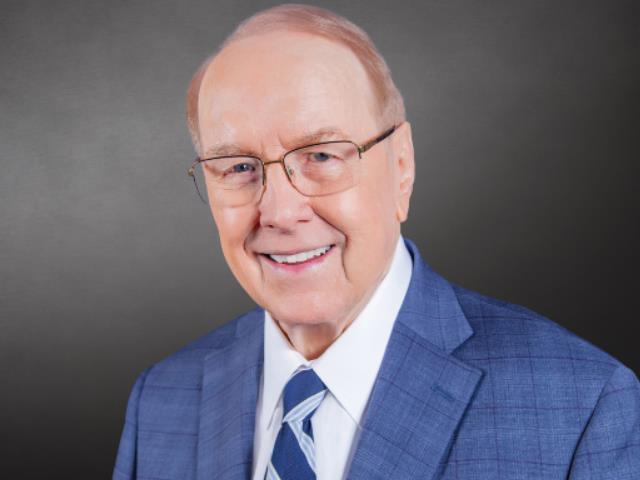
Behind the doors of nursing homes across America, countless seniors wait for someone who cares. On today’s edition of Family Talk, Dr. James Dobson shares a moving conversation with the late Missy Tate, who devoted her life to ministering in retirement homes. She reveals how a simple song, a gentle touch, and the love of Christ can transform forgotten lives.
Dr. James Dobson: Welcome everyone to Family Talk. It's a ministry of the James Dobson Family Institute, supported by listeners just like you. I'm Dr. James Dobson, and I'm thrilled that you've joined us.
Roger Marsh: Well, welcome to this special edition of Dr. James Dobson's Family Talk. Family Talk, of course, is the broadcast division of the Dr. James Dobson Family Institute. I'm Roger Marsh, and today we are reflecting on the value that we place on the elderly in our lives. This was a topic near and dear to Dr. Dobson's heart, and it's one that touches all of us in one way or another. In fact, the elder community is a growing part of our society. It is projected that by the year 2030, which is only four years from now, nearly one out of every five Americans will be classified as a senior citizen. Speaking from experience, it's not a bad place to be, but keep in mind that is a significant portion of the population. And yet, so many of our precious seniors feel forgotten, sitting alone and wondering if anyone still cares about them at all. On today's edition of Family Talk, we're going to hear a conversation Dr. Dobson had with the late Missy Tate, who dedicated her life to bringing the love of Christ into nursing homes all across the country. She sang in rest homes, she spoke with the lonely, and shared hope with people that the world would just as soon forget. Her stories are truly incredible, so let's listen now as Dr. Dobson sets up today's conversation here on Family Talk.
Dr. James Dobson: I received a personal letter from a friend of mine named Rudy Mark-Miller. Rudy has been a great friend to me for more than 30 years, and I talked to him just the other day. On this occasion, he shared a suggestion with me which I took very seriously because it came from Rudy and because it was a good idea. Rudy wrote, "Your radio program addresses Mother's Day and Father's Day and Valentine's Day in the most sensitive and beautiful ways. Is it possible once in a while to do a program which reminds us of our forgotten moms and dads and sisters and brothers and friends who are in rest homes or live alone and face each day, Christmas included, not knowing who cares about them or even acknowledges their existence more than once a year?" Do you know a lot of those people write to us? In kind of shaky handwriting for someone that may be 80 or 90, and just writes to say, "I listen to you. I'm blessed by what you do. I'm praying for you." Those people really touch my heart. They've obviously touched Rudy's heart, and he passed along this idea that we ought to talk about the elderly and their needs for love and care as the years roll by. That's exactly what we're going to do today. What we're seeing is a reversing of the demographic pyramid, where fewer young people are encouraging and supporting the older population. A lot of people are neglected because of that, and we need to focus more on those that are, in some cases, the least of these, my brethren. Many of them have no money at all, and my heart goes out to these folks. I mentioned earlier that we get letters from people. They often apologize because they can't help us. We just want to know what we can do for you. There are often some tears that go along with that. We were talking to Missy Tate, who joined us in the studio to talk about this subject. Missy went home to be with the Lord in 2005, but at the time of our recording, she was the head of Missy Tate Ministries, which ministered to people in nursing homes. She would sing and speak in rest homes all over the country. She was truly a blessing to everyone who came in contact with her, and she shared the love of Christ with those that many in the world would just as soon forget. Well, with that, let's listen in now as we share this rich conversation with the late Missy Tate right here on Family Talk. Missy, you're an ideal person to discuss what we've been talking about and the suggestion from Rudy Mark-Miller. It is really a delight to have you here.
Missy Tate: Dr. Dobson, it's an honor. It really is.
Dr. James Dobson: Tell me, why of all the things that you could devote your life to, you chose going into the places that some people would consider depressing and unpleasant?
Missy Tate: I feel it very comfortable. I know that's where God is leading me. I truly feel that going into a nursing home setting is a very comfortable situation for me. But I also know that I'm going to meet a group of people that have certain needs, and hopefully God will help me meet those needs for them.
Dr. James Dobson: It's heartbreaking to see it, isn't it?
Missy Tate: Well, for some people it is. I don't find it that way. I find it a joyous opportunity because these people are at the jumping-off point. They are ready to go to heaven, and I just feel it's a great opportunity to minister to them. I think that's where the story of Irma comes in and why I'm doing what I'm doing. Irma—I was there the day she was brought into the nursing home. She was 87 years old, and boy was she something to behold. She was a real detriment to the nursing home. She'd curse at you, she'd call you everything in the book. I went away on summer vacation and came back, and the recreational director came up to me and said, "You have to sing with Irma." I said, "Are you kidding? She'll swat me." "No, no, no. Go up to the microphone and sing with her." And I did. Oh, she had a beautiful voice. Found out she was her church organist. She had definitely changed. I asked her nurses and they said she had a personality change. I asked her doctors; they said it was her medicine. Well, I went into her room one afternoon and I said, "Irma, it's Missy." "Oh yes, the nice lady who sings with me." And I said, "Yes, Irma, you're different." "Oh, I know I am." I said, "What changed you?" She said, "Well, I know you asked me a lot to come down to those meetings. I liked the music but I didn't want to hear any preaching. But I rolled my wheelchair close enough one day, and I heard the pastor say, 'If you'd only raise your hand and ask Jesus in your heart, you will have peace.' Missy, I had nothing left in life. I raised my hand. I know two things: I know where I'm going when I die, and I know I can accept any circumstance I'm in." Through that grew a ministry of sharing Christ with our seniors.
Dr. James Dobson: What are those homes and institutions like? Describe what happens there.
Missy Tate: Well, there's a variety. I think some of them are beautiful, very palatial. Some are in between, and then some are at the other spectrum, rather smelly and dirty and that type of thing. But they are filled with people that have great expectations, but there's a lot of loneliness there too. The statistic was 87% of nursing home patients did not receive one visitor in their stay at the nursing home.
Dr. James Dobson: Can you put a human face on that? What's that loneliness like? You've met so many people there. Can you help us understand that? Statistics don't get it done. What does that really mean?
Missy Tate: Basically, there's a schedule that they keep. They get up in the morning, they're washed, they're fed, and then they sit and they wait. The recreational director many times plans programs, plans activities. Then they eat, then they take a nap, then there's another activity, then they eat, and then they go to bed. It's a very scheduled situation day after day.
Dr. James Dobson: I flew into Chicago many years ago as a young man on a business trip. There was a big convention there and the hotel that I had reservations at had lost those reservations. They felt responsible for me, but they didn't have any room for me. They started calling trying to find a place for me to go that night, and they called all over the place. They finally found a room in a nursing home—a big 10-story building that had been a hotel that had gone bankrupt and then had been given to that purpose. So I drove out to a suburb of Chicago and spent the night in that nursing home. The next morning, my eyes were really opened. I went down to the lobby and there were these old people sitting in wheelchairs all over the place—maybe a hundred people down there. What struck me most and frankly depressed me was that nobody talked to anybody else. There was no interchange. They just sat and stared. Is that characteristic of nursing homes?
Missy Tate: That's characteristic when they're lined up in the hall, but it's not characteristic of them when they're in a group setting. When they're in a group setting, they will respond to the person next to them, which sometimes is their own roommate. But it's a very self-centered, self-focused environment. There's not a lot of social life in a place like that.
Dr. James Dobson: So loneliness grows not only because family and friends don't come, but because there's not a lot of social interaction inside. I have a poem here that I've had in my file for a long time. This is entitled "Minnie Remembers," and I think it'll help illustrate what we're talking about. "God, my hands are old. I've never said that out loud before, but they are. I was so proud of them once. They were soft like the velvet smoothness of a firm ripe peach. Now the softness is more like worn-out sheets or withered leaves. When did these slender graceful hands become gnarled shrunken claws? When, God? They lie here in my lap, naked reminders of this worn-out body that has served me too well. How long has it been since someone touched me? 20 years? 20 years I've been a widow—respected, smiled at, but never touched. Never held so close that loneliness was blotted out. I remember how my mother used to hold me, God. When I was hurt in spirit or flesh, she would gather me close and stroke my silky hair and caress my back with her warm hands. Oh God, I'm so lonely. I remember the first boy who ever kissed me. We were both so new at that. The taste of young lips and popcorn. The feeling inside of mysteries to come. I remember Hank and the babies. How else can I remember them but together? Out of the fumbling awkward attempts of new lovers came the babies, and as they grew, so did our love. And God, Hank didn't seem to mind if my body thickened and faded a little. He still loved it and touched it. And we didn't mind if we were no longer beautiful, and it felt so good. And the children hugged me a lot. Oh God, I'm so lonely. God, why didn't we raise the kids to be silly and affectionate as well as dignified and proper? You see, they do their duty. They drive up in their fine cars. They come to my room and pay their respects. They chatter brightly and reminisce, but they don't touch me. They call me Mom or Mother or Grandma—never Minnie. My mother called me Minnie. So did my friends. Hank called me Minnie too, but they're gone. And so is Minnie. And only Grandma is here. And God, she's lonely." Isn't that beautiful? And it conveys what you have seen as you have interacted with people.
Missy Tate: Oh, for sure. I love the story of Lily. Lily had been in a local nursing home for over 15 years, and she touched my hand one day and she said, "Missy, why is it taking so long?" I said, "Lily, taking so long for what?" She said, "To die." I said, "Lily, God must want you to be a blessing to someone. That's why he's leaving you here a while." And she said, "A blessing? Why a blessing?" I said, "Well, it's up to God, Lily. But he wants you to be a blessing to someone." She said, "Me? Who could I ever be a blessing to?" And I said, "Well, maybe to a roommate, maybe to a loved one, maybe to a grandchild. But that's why he's keeping you here so long." She said, "Well then, I'm willing to wait." Fill that loneliness.
Dr. James Dobson: Missy, let's talk about the practical side of this. There are people out there who have loved ones, relatives, mothers, fathers that are in nursing homes and have not really done their duty to them. It's obvious what we would like them to do and what we're suggesting that they do. For all the others who are listening, you're suggesting that even if they don't have someone there that they know, that they go to a nursing home and attempt to reach out to them and love them. How does one do that? You walk through the front door and the nurse says, "Why are you here?" and you say...
Missy Tate: Well, I would suggest a phone call first, but you can go to the front door, that's fine. But you get a hold of the recreational director and say, "I really would like to come and do whatever I can for your people here." But go, and don't go at the holiday time. They're inundated with people at the holiday time. Go in the dead of winter, go in the dead of summer when they have no one there.
Dr. James Dobson: Have you had many experiences where the light went on and a person in the last chapter of life all of a sudden recognizes what they've missed to this point?
Missy Tate: That's why I'm here and that's why I'm doing what I'm doing. And why you're recommending it to others. You dealt with one woman who had Alzheimer's in particular. Audrey—I hope we can play that tape. But Audrey was an 82-year-old woman, and she had been in the nursing home for about eight years. Audrey had forgotten how to walk, how to talk, how to eat, and her hair of course was matted. She would come down to the meetings and really people got so they ignored her except for physical situations. I walked up to her one day with a microphone and I said, "Audrey, would you like to sing with me?" and she went "Mmm." You hear that on the tape. And then all of a sudden she breaks into "In the Garden," "I come to the garden alone," and the wonderful thing is it's in beautiful harmony. Do you know that same thing happened to my mother? She was unable to communicate. My mother had Parkinson's disease and she had really kind of shrunk to about an 80-pound little frame. But a year before that, when the process hadn't gone quite that far, my friends Robert and Bobby Wolgemuth went with me to see her. We sat on the bed and sang to her. Robert and Bobby have great voices, and they began singing the old hymns, and my mother, who could not talk, did the same thing because it comes from the other side of the brain. She sang in alto—beautiful alto—all the words in the right place. I sat there and bawled like a baby. Let's hear the tape you're talking about.
Audrey: (Singing) I come to the garden alone / while the dew is still on the roses / and the voice I hear calling on my ear / the Son of God discloses. / And he walks with me and he talks with me / and he tells me I am his own / and the joy we share as we tarry there / none other has ever known.
Dr. James Dobson: Missy, in the first place, that's an emotional song, and then to have Audrey sing it with you, that must have surprised you when she chimed in there.
Missy Tate: Oh, it surprised me. But the nurses that had cared for her those eight years, they were just overwhelmed and in tears. That was amazing.
Dr. James Dobson: So what you're saying through all this is even though there's a giving relationship and you're giving your life to go into places and reach out to people who really can't give you a lot back, you do get something back, don't you?
Missy Tate: Oh my, yes.
Dr. James Dobson: Missy, this is wonderful. This is such valuable information and motivation, I hope. We have five principles that this ministry is based on, and one of the five is the worth of the individual without regard to the circumstances in which life is expressed. So those who are not productive, those who are the rejected, the handicapped, and the elderly who languish in these nursing homes are all of equal worth. We're not on a hierarchy. Some aren't more valuable than others. And yet those people sit there and wait for somebody to care.
Missy Tate: Jeremiah 8:20 says, "The summer is over, the harvest is here, and we are not saved." And those are our seniors.
Dr. James Dobson: This is the last opportunity for many of them, isn't it? And if we don't reach out, who will? The thought that some of those people can spend eternity in heaven because of our effort is very exciting to me. Thank you, Missy, appreciate you being with us.
Missy Tate: Thank you.
Dr. James Dobson: You know what I'm mindful of as we're talking about this subject? We are talking directly to a lot of people who are in that situation. They're listening to the radio in a nursing home, perhaps, and maybe there's a little tear in the corner of the eye because somebody has articulated what they've been feeling and what they need. If we have put an arm around them, what a great way to invest a broadcast. I want to share a Scripture, a very familiar Scripture from the words of Jesus. It's in Matthew 25:34-40, and we've heard this before, but let's listen again and ask ourselves if we are truly conforming to this standard that God has set for us. He said in verse 34, "Then the King will say to those on His right hand, 'Come, you blessed of My Father, inherit the kingdom prepared for you from the foundation of the world: for I was hungry and you gave Me food; I was thirsty and you gave Me drink; I was a stranger and you took Me in; I was naked and you clothed Me; I was sick and you visited Me; I was in prison and you came to Me.' "Then the righteous will answer Him, saying, 'Lord, when did we see You hungry and feed You, or thirsty and give You drink? When did we see You a stranger and take You in, or naked and clothe You? Or when did we see You sick, or in prison, and come to You?' And the King will answer and say to them, 'Assuredly, I say to you, inasmuch as you did it to one of the least of these My brethren, you did it to Me.'" Isn't that beautiful?
Roger Marsh: Every person carries worth and dignity, right down to the very last chapter of life. And what a great reminder today here on Family Talk as we listen to this heartfelt conversation featuring our own Dr. James Dobson and the late Missy Tate. If you'd like to hear this program again or to share it with someone who needs a little encouragement, you'll find the audio at drjamesdobson.org. Day in and day out, the Dr. James Dobson Family Institute exists to strengthen the family and to point people to the truth of God's word. Even though culture changes on a daily basis, we are committed to sharing timeless wisdom that endures. Not long ago, we heard from a listener who put it better than I ever could. She called us and said, "I really appreciate Family Talk. I am of the older generation, in the 80s and 90s in our family, and I struggle being computer or tech-savvy. But the clarity of the word of God and the testimonies on the radio have blessed me, and I thank you all for sticking with radio. Landlines are gone, so much is gone. So many changes, everything's becoming obsolete except for what God has done in our lives. That work will live on forever. So thank you all for being a part of it." Well, we are truly blessed and encouraged whenever one of our listeners reaches out and shares with us what this program means to them. And it's all made possible because of friends like you who have chosen to stand behind this work. When you donate to the Dr. James Dobson Family Institute, you help keep this trusted program on the air for millions of people who are counting on it. You can make a secure donation by visiting jdfi.org. If you prefer, you can speak with a member of our constituent care team; that number is 877-732-6825. Or if you'd like to write to us, our ministry mailing address is the Dr. James Dobson Family Institute, PO Box 39000, Colorado Springs, Colorado, 80949. I'm Roger Marsh, and from all of us here at Family Talk and the Dr. James Dobson Family Institute, thanks so much for listening today. Be sure to join us again next time right here for another edition of Dr. James Dobson's Family Talk, the voice you trust for the family you love.
Dr. James Dobson: It's not unusual for parents of strong-willed children to struggle with feelings of guilt and self-doubt over the constant tug of war in their homes. Here's today's Dr. Dobson Minute. Unfortunately, too many parents have been told by the experts that managing children should be duck soup for those who do it right. That leaves them with intense self-condemnation when things don't work out so smoothly. If you're facing this kind of tension in your own life, let me give you three assurances. First, it isn't all your fault. Second, it won't always be so difficult. And third, you're probably doing a much better job than you think. Statistics show that most strong-willed kids later become stalwart, respectable, hard-working adults who can't believe some of the things they used to do. You may even see the day when your formerly defiant offspring comes to you for advice, worn out from the tug of war with his own very strong-willed child. For more information, visit drdobsonminute.org.
Related Episodes
A Picture of Life, Part 2
Friday, August 28
A Picture of Life, Part 1
Thursday, August 27
In the Business of Serving God
Wednesday, August 26
Related Videos
About Family Talk
Family Talk is a Christian non-profit organization located in Colorado Springs, Colorado. Founded in 2010 by Dr. James Dobson, the ministry promotes and teaches biblical principles that support marriage, family, and child-development. Since its inception, Family Talk has served millions of families with broadcasts, monthly newsletters, feature articles, videos, blogs, books and other resources available on demand via its website, mobile apps, and social media platforms.
The Dr. James Dobson Family Institute (JDFI) is a Christian non-profit ministry located in Colorado Springs, Colorado. Founded initially as Family Talk in 2010 by Dr. James Dobson, the organization promotes and teaches biblical principles that support marriage, family, and child development. Since its inception, Family Talk has served families with broadcasts, monthly newsletters, feature articles, videos, blogs, books, and other resources available on demand via their website, mobile apps, and social media platforms. In 2017, the ministry rebranded under JDFI to expand its four core ministry divisions consisting of the Family Talk radio broadcast, the Dobson Policy and Education Centers, and the Dobson Digital Library.
Dr. Dobson's flagship broadcast called, “Dr. James Dobson’s Family Talk," is aired on more than 1,500 terrestrial radio outlets and numerous digital channels that reach millions each month.
About Dr. James Dobson
Dr. James Dobson is the Founder Chairman of the James Dobson Family Institute, a nonprofit organization that produces his radio program, “Dr. James Dobson's Family Talk.” He has an earned Ph.D. from the University of Southern California and holds 18 honorary doctoral degrees. He is the author of more than 70 books dedicated to the preservation of the family including, The New Dare to Discipline, Love for a Lifetime, Life on the Edge, Love Must Be Tough, The New Strong-Willed Child, When God Doesn't Make Sense, Bringing Up Boys, Bringing Up Girls, and, most recently, Your Legacy: The Greatest Gift. Dr. Dobson served as an associate clinical professor of pediatrics at the University of Southern California School of Medicine for 14 years and on the attending staff of Children’s Hospital of Los Angeles for 17 years in the divisions of Child Development and Medical Genetics. He has advised five U.S. presidents and served on eight national commissions. Dr. Dobson has been married to Shirley for 64 years, and they have two grown children, Danae and Ryan, and two grandchildren.
Contact Family Talk with Dr. James Dobson
540 Elkton Drive
Suite 201
Colorado Springs, CO 80907
Phone Number
877.732.6825

